Commercial Water Damage Restoration Nashville, Planned Around Your Trading Hours
A burst pipe on the third floor does not close a business. Standing water does. Commercial water damage restoration Nashville companies rely on is built around one fact: every closed day costs more than the drying. The work is phased so the dry part of your building keeps trading, the wet part is dried under containment, and every step is documented for your insurer, your landlord and your lease. This service connects Nashville businesses with independent local restoration providers who work that way.
- Phased drying, stay open where you can
- After-hours and weekend work
- Insurer and landlord documentation
- Independent local providers
The drying bill is rarely the biggest cost
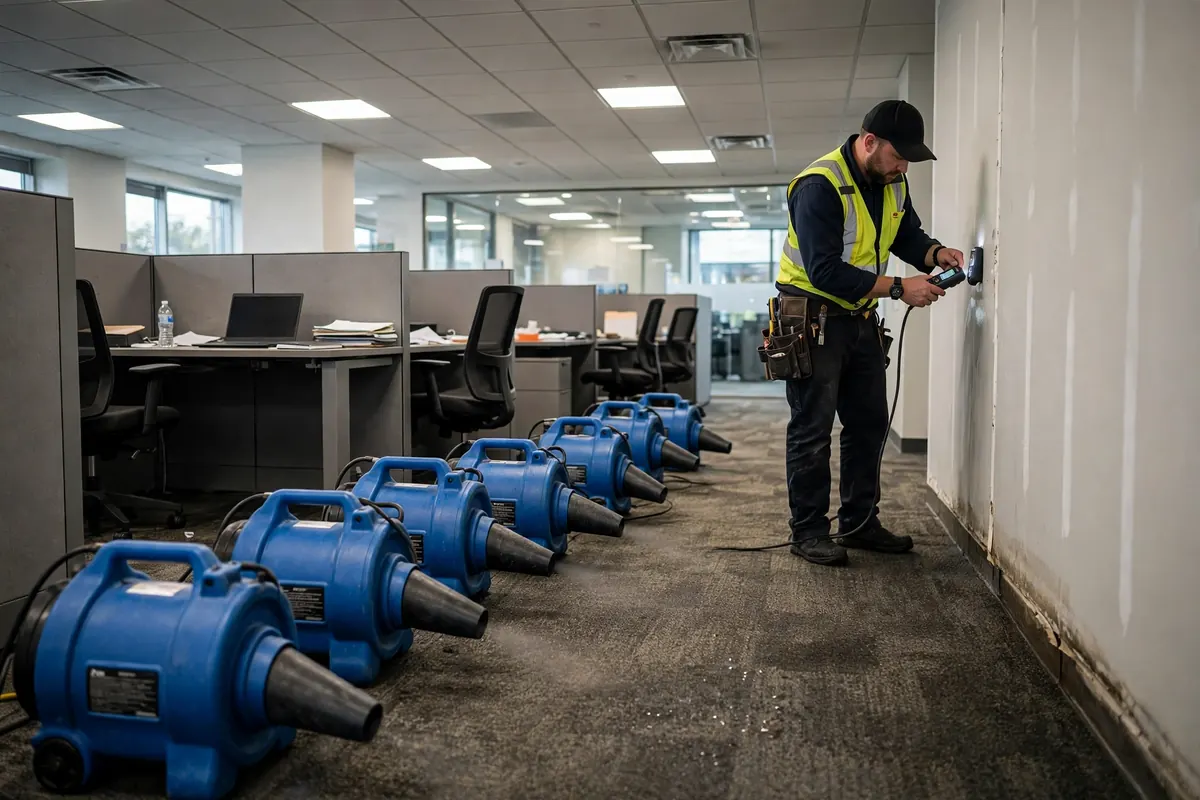
Commercial water damage restoration in Nashville is planned around one goal: keep the business trading. Work is phased so part of the building stays open, drying runs after hours where it can, and every step is documented for the insurer, the landlord and the lease. Downtime, not the drying bill, is usually the biggest cost.
Commercial water damage Nashville businesses deal with arrives from the same sources as the home version, at a bigger scale. Roof drains and HVAC condensate on flat-roofed buildings in the Nations and Berry Hill. Sprinkler lines and aging galvanized pipe in downtown towers. Supply lines in the restaurant rows, where a failed line at 3am runs until the opening shift finds it. Storm water through loading docks and ground-floor units along the Mill Creek corridor in Antioch, and the Cumberland flats where Nashville keeps its warehouses. The buildings differ. The first job is always the same: stop the water, protect the stock and the systems, and get a drying plan that a business can actually trade around.
Commercial water damage restoration Nashville services, matched to the building
The drying science is the same everywhere. The plan around it is not.
Offices
The classic office water damage restoration Nashville managers deal with starts above the ceiling: a condensate line, a restroom supply line, a roof drain. Work runs floor by floor, server rooms and document storage get protected first, and drying is scheduled so staff are working around fans for days, not weeks.
Retail
For a shop, the sales floor is the business. Stock comes off the floor and out of the water first, drying runs overnight, and the scope is split so the store can reopen on a reduced floor while the stockroom and offices rebuild behind it.
Restaurants
Water in a kitchen is a health question before it is a building question. Contaminated water closes the kitchen until surfaces are cleaned and cleared, and reopening waits on inspection. The plan sequences cleaning, drying and the inspector's visit so no step is paid for twice.
Warehouses and light industrial
Big slabs, racking and dock doors. Storm water and roof leaks spread wide and shallow, so extraction is a pumping job and drying is a question of air movement over large areas. Inventory documentation runs alongside, because the stock claim is often bigger than the building claim.
Multi-family and rentals
One unit's pipe is three units' problem. Landlords and managers need the source fixed, each affected unit documented separately for separate claims, and tenants told plainly how long their home is disrupted. Fast, documented drying is what keeps a water loss from becoming a lease dispute.
What it costs a business
Commercial pricing follows the same logic as residential: extraction, drying days and rebuild, priced from a written scope. Our restoration cost guide shows the published Nashville ranges for the residential side and explains how to read any quote line by line before you sign it.
Read the cost guidePhased drying, containment and after-hours work
The commercial water damage restoration services Nashville businesses hire earn their fee in the planning, not the pumping. The first moisture survey divides the building into zones: what is wet, what is damp, what is dry. Wet zones are sealed under containment, negative air keeps dust and spores out of the trading areas, and drying equipment is sized to the zone instead of the whole building. As zones pass their moisture readings, they hand back to the business and the containment line moves.
The noisy, disruptive stages, extraction and any demolition, are pushed to evenings, nights and closed days wherever the building allows. Drying itself is quiet work that runs unattended, with the crew returning for readings and adjustments. A business that understands the phase plan can tell its own customers exactly what is open and what is not, which is worth money on its own.
- Containment first. Plastic barriers and negative air keep the work zone's dust out of your trading space, your stock and your HVAC system.
- Readings, not guesses. Daily moisture readings decide when a zone is done. The readings are also your claim record and your landlord's proof.
- Protect what earns. Stock, servers, files and kitchen equipment are moved or covered before drying starts, not after the first fan tips something over.
- One scope, in writing. Zones, phases, after-hours schedule and the dry standard, agreed before work starts. Compare it against the water damage restoration Nashville standard on our homepage.
Disaster recovery is a plan you write on a dry day
The businesses that lose least to water are the ones that treated commercial disaster recovery services Nashville providers offer as planning, not just cleanup. The plan is short: know where every shutoff valve is and label it, keep a photo record of the building and its contents while everything is dry, agree in advance who makes the calls, the insurer, the landlord, the restoration provider, and keep that list somewhere that is not inside the building that floods.
Nashville adds its own rows to that list. A business in the Mill Creek corridor or on the Cumberland flats should know its flood history the way Bellevue learned its own in May 2010, and a business under a flat roof should know its drains are cleared before the spring storms, not during them. None of this is expensive. All of it is cheaper than learning it standing in water, and a river or storm loss is handled the same way as our flood cleanup crews handle homes, scaled to the building.
Two claims run at once on a commercial loss
The property claim
The building and contents damage, paid on the provider's documentation: dated photos, moisture maps, equipment logs and the itemized scope. Sudden failures, a burst line, a sprinkler discharge, a roof failure in a storm, are the core of commercial cover. Gradual leaks and rising flood water sit outside it, the same sudden-versus-gradual line that decides home claims.
The interruption claim
Lost income while you are closed or cut back, paid on your trading records set against the restoration timeline. This is why the phase plan matters beyond convenience: every day the plan wins back is a day that claim does not have to argue about. Keep the two claims in one file, because the adjusters will read them against each other.
General patterns for Tennessee commercial policies, not advice about yours. When a loss involves fire as well as water, the process on our fire damage restoration page runs alongside this one.
Common questions from Nashville businesses
Can our business stay open during commercial water damage restoration?
Often, yes, in part. The usual pattern is phased work: the wettest area is closed and dried under containment while the rest of the building keeps trading, then the crew rotates. A restaurant might lose its dining room for two days and keep takeaway running from a dry kitchen. What cannot stay open is any area where the water is contaminated, where ceilings are saturated, or where electrical systems are wet. The provider should walk you through exactly which areas close, and for how long, before the equipment goes in.
Can the drying work happen after hours?
A large share of it can, and on commercial jobs it usually does. Extraction and demolition are noisy and are often scheduled for evenings, nights or the days the business is closed. Drying equipment then runs unattended around the clock, checked on scheduled visits for moisture readings. After-hours scheduling is part of the scope conversation on a commercial job, not a special favor, because the provider knows the alternative is a longer closure.
Who needs the documentation from a commercial water loss?
More people than on a home claim. Your insurer works from the moisture readings, photos and itemized scope. Your landlord may require proof the unit was dried to standard before you reopen or before the lease deposit is discussed. Tenants in neighboring units may have their own claims if water crossed a party wall or a floor slab. And your own records matter at tax and audit time. A proper commercial scope is written so all of those readers can use it.
Will insurance cover the income we lose while closed?
Business interruption cover is a separate part of most commercial policies, and it responds when a covered event, such as a burst pipe or a failed sprinkler line, forces you to close or cut back. It does not respond to gradual leaks, worn-out plumbing or flooding from outside without a flood policy. The claim is paid on records: the restoration timeline, your closure dates and your trading figures. Start the interruption claim the same day as the property claim, and keep both files together.
How long does a commercial water damage job take?
Drying on a commercial job usually runs 3 to 5 days, the same as a home, but the building type changes the tail. A single office suite can be dry and rebuilt inside two weeks. A warehouse with saturated racking areas, or a restaurant waiting on health re-inspection, runs longer. The honest answer comes from the first moisture survey: your provider should give you a drying timeline and a rebuild timeline separately, in writing, with the items that could stretch each one named.
What should a facilities manager do in the first hour of a commercial water loss?
Stop the water at the zone valve or the main, and know where that valve is before you ever need it. Kill power to wet areas, keep staff and customers out of them, and move stock, files and electronics above the water line. Photograph everything before mopping starts, call your insurer's commercial claims line, then call for extraction. The businesses that come out of a water loss best are the ones whose manager had the shutoff locations written down in advance.
Water in your building right now?
Shut the water off, keep people out of the wet areas, and get the phase plan started before the next trading day is lost. Reach out now and get connected with a local provider who does commercial work across Nashville and Davidson County. The residential side of the service lives on our water damage restoration Nashville homepage.
Get Help Now